| Home
Ocean Liners 1
RMS Titanic
The Cunarders 1
Ocean Liners Photos
Favourite Links
Contact Me
Please Sign My Guestbook
|
|
Summary
This is the first page about the most famous of the Cunard Line's ocean liners. Here I tell you a little about the three White Star Line's biggest rivals: 'Lusitania', 'Mauretania' and 'Aquitania'.
|
| |
The 'Lusitania'
Launched on June 7th 1907 she was the world's largest ship of that time. She made her maiden voyage on September 7th 1907 from Liverpool to New York via Queenstown. In October of that year, on her second voyage, 'Lusitania' took the transatlantic record from Norddeutscher Lloyd's 'Kaiser Wilhelm II' with an average speed of 23.99 knots from Queenstown to Sandy Hook, the passage time being 4 days, 19 hours and 52 minutes. The Blue Riband was held by Britain for the next 22 years. On May 7th 1915 she was torpedoed by 'U-20' off the Old Head of Kinsale whilst approaching Queenstown. The torpedo hit between the first and second funnels. The ship heeled over to starboard and sank within 18 minutes. 1,198 lives were lost. |
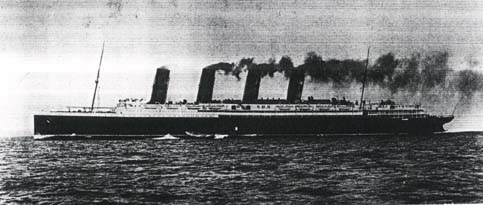 'Lusitania' at sea
 |
| |
The 'Mauretania'
Her maiden voyage was on November 16th 1907 on the Liverpool to New York via Queenstown route. On the return leg she took the Blue Riband from 'Lusitania' with a run of 23.69 knots average between Ambrose Lightship and Queenstown with a passage of 4 days, 22 hours and 29 minutes. 'Lusitania' retook the Blue Riband in 1908 and in July 1909, 'Mauretania' crossed in 4 days 17 hours and 20 minutes at 25.89 knots and held the record until 1929 when Norddeutscher Lloyd's 'Bremen' took it from her. In August 1914 she was commissioned as a transport and later used as a hospital ship. She was laid up at Greenock from 1916 to 1917. She was used as a US troopship in 1917 and in June 1919 she resumed Cunard service from Southampton to New York. On July 25th 1921 she was damaged by fire at Southampton and was repaired and converted to oil fuel. In August 1929 'Mauretania' improved her own Atlantic record with an average speed of 27.65 knots crossing in 4 days, 17 hours and 50 minutes. She had her hull painted white for cruising in 1931 and was known as the "Grand Old Lady". On September 26th 1934 she made her final voyage. This was also the date of the 'Queen Mary's launch. 'Mauretania' was then withdrawn from service. On 2nd April 1935 she was sold to Metal Industries for scrap. On July 1st, the same year, she left Southampton for Rosyth, Firth of Forth. To pass under the Forth Bridge, her masts had to be cut off at funnel height. |
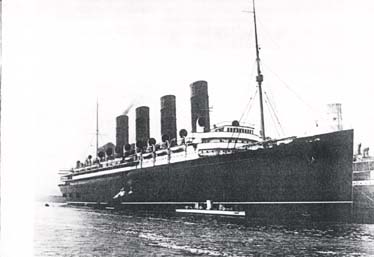 'Mauretania' in port
 |
| |
The 'Aquitania'
The 'Aquitania' sailed on her maiden voyage in May 1914. In August same year she was commandeered as an armed merchant cruiser but, due to a collision she was considered too big so in 1915, she was dazzle painted and used as a troopship. In 1916 and 1917 she was used as a hospital ship. In June 1919 she resumed her North Atlantic service serving the Southampton to New York via Cherbourg route. Between 1919 and 1920 she was converted to oil burning and fitted with a Gyro compass. In November 1939 she was requisitioned as a troopship. In November 1949 she sailed her final Cunard voyage from Halifax to Southampton arriving on December 1st. In 1950 she was eventually broken up at Ganeloch, Scotland. During her career she steamed over 3 million miles and crossed the Atlantic 475 times. She was the last liner to be built with four funnels and the only four-stacker to survive both world wars. |
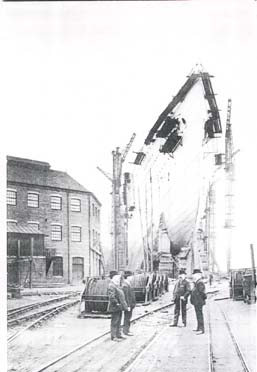 'Aquitania' under construction
 |
|


